

- What Is a Hybrid SUV? Why Can It Save Fuel?
- Official Fuel Economy Figures: Hybrid vs. Gasoline
- Real-World Fuel Economy: The Gap Between Ideal and Reality
- Do the Math: Calculate How Much You Can Save on Gas Each Year
- Plug-in Hybrid SUVs (PHEVs): Devastating Fuel Savings
- Conclusion: Saving Real Money, Embracing a Better Experience
- Frequently Asked Questions (FAQ)
Hybrid SUVs have become hugely popular in global markets in recent years, especially in overseas markets such as North America, Europe, and Australia. Whether it is the Toyota RAV4 Hybrid, the Honda CR-V Hybrid, or the Hyundai Tucson Hybrid, these models are increasingly common on the road. Without a doubt, fuel savings are the number one reason most buyers choose a hybrid. Yet one core question always lingers in consumers’ minds: How much fuel can a hybrid SUV actually save in real terms? This article will use real-world data from overseas markets to give you a thorough analysis.
What Is a Hybrid SUV? Why Can It Save Fuel?
Before diving into the data, we first need to briefly understand the working principle of a hybrid SUV. Usually, the “hybrid” we refer to means a hybrid electric vehicle (HEV), which does not require external charging. In simple terms, it uses a small battery pack and an electric motor to assist a traditional internal combustion engine.
So how does it save fuel? The most critical point is that it can recover energy. When braking or coasting, the electric motor reverses to become a generator, converting kinetic energy into electrical energy and storing it in the battery. Then, when starting off or driving at low speeds – the stages where the engine is least efficient – the vehicle prioritizes electric drive. As a result, the engine can always operate in its optimal efficiency zone, avoiding wasted fuel. In addition, the engine automatically shuts off when waiting at red lights or during temporary stops, completely eliminating idle fuel consumption.
It is worth mentioning that there is also a category of plug-in hybrid SUVs (PHEVs), such as the RAV4 Prime or the Mitsubishi Outlander PHEV, which can be charged externally just like pure electric vehicles, typically delivering an all-electric range of 40–80 kilometers. We will explore the fuel-saving potential of both types separately later on.
Official Fuel Economy Figures: Hybrid vs. Gasoline
To show the gap most intuitively, let us first focus on official fuel economy data from authoritative agencies. Using U.S. EPA and European WLTP standards as references, we select several popular SUVs and directly compare their hybrid and pure gasoline versions.

Toyota RAV4
- Gasoline version (2.5L, AWD): Combined fuel economy 30 MPG (approximately 7.8 L/100km)
- Hybrid version (Hybrid, AWD): Combined fuel economy 40 MPG (approximately 5.9 L/100km)
- Fuel savings percentage: approximately 33%

Honda CR-V
- Gasoline version (1.5T, AWD): Combined fuel economy 29 MPG (approximately 8.1 L/100km)
- Hybrid version (Hybrid, AWD): Combined fuel economy 37 MPG (approximately 6.4 L/100km)
- Fuel savings percentage: approximately 27%
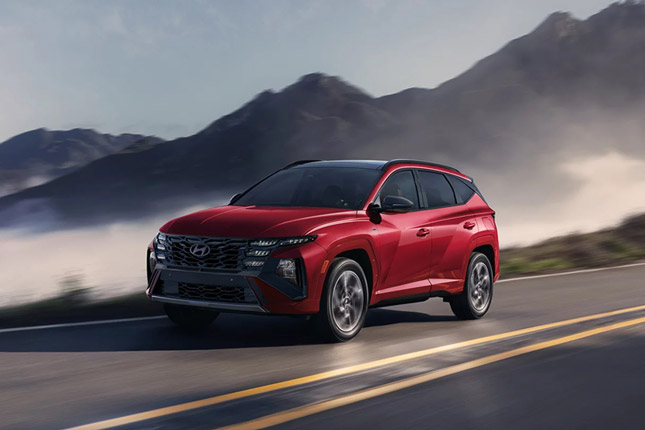
Hyundai Tucson
- Gasoline version (2.5L, AWD): Combined fuel economy 26 MPG (approximately 9.0 L/100km)
- Hybrid version (Hybrid, AWD): Combined fuel economy 37 MPG (approximately 6.4 L/100km)
- Fuel savings percentage: up to 42%
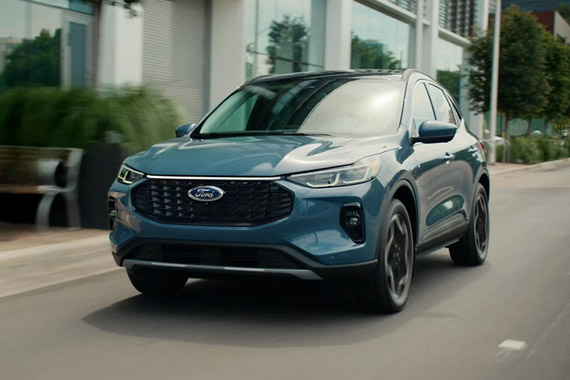
Ford Escape
- Gasoline version (1.5T, AWD): Combined fuel economy 28 MPG (approximately 8.4 L/100km)
- Hybrid version (Hybrid, AWD): Combined fuel economy 40 MPG (approximately 5.9 L/100km)
- Fuel savings percentage: approximately 43%
From the comparison above, it is clear that, compared with their respective pure gasoline versions, mainstream hybrid SUVs generally reduce combined fuel consumption by 25% to 40%. Notably, Hyundai’s and Ford’s hybrid systems are particularly effective at saving fuel in urban driving conditions, making their overall savings even more significant.
Real-World Fuel Economy: The Gap Between Ideal and Reality
Official data, however, is derived from standardized tests. What happens in real-world driving? This is precisely where hybrid SUVs demonstrate their unique strengths.
In urban driving conditions, frequent stop-and-go traffic creates an excellent opportunity for the energy recovery system to shine. As a result, real-world fuel consumption of hybrid SUVs is often very close to or even lower than the official figures. Many owners report that, when driving a hybrid RAV4 or CR-V in the city, it is common to easily achieve fuel consumption below 6 L/100km (or 39 MPG). In contrast, the fuel consumption of pure gasoline SUVs skyrockets in the city, easily exceeding 10 L/100km (or 23 MPG).
When cruising on the highway, the situation is different. Because there are fewer braking opportunities to recover energy and the vehicle needs to overcome air resistance, the advantage of the hybrid system is relatively reduced. That is to say, on the highway, the fuel consumption gap between the hybrid and gasoline versions narrows, but the hybrid still maintains a 5%–15% advantage.
For example, one user shared on a forum that the real-world combined fuel consumption of his hybrid Tucson was consistently around 6.5 L/100km (36 MPG), while his colleague’s gasoline Tucson never went below 9.5 L/100km (25 MPG). This shows that the real-world savings percentage can be even more impressive than the official data, especially for city commuters.
Do the Math: Calculate How Much You Can Save on Gas Each Year
So, how much money does this saved fuel actually translate into? Let us do an annual cost calculation using common units and fuel prices.
Assumptions:
- Annual driving distance: 15,000 miles (approximately 24,140 kilometers, in line with the driving habits of many households in North America and Australia)
- Local fuel price: $3.60/gallon (referencing the average U.S. gasoline price in recent years; adjust according to your region)
- Comparison model: Taking the mid-range savings of the Toyota RAV4 gasoline version vs. hybrid version, using the EPA combined fuel economy figures mentioned earlier.
The annual fuel cost calculation is as follows:
Gasoline RAV4 (30 MPG):
15,000 miles ÷ 30 MPG × $3.60/gallon = $1,800
Hybrid RAV4 (40 MPG):
15,000 miles ÷ 40 MPG × $3.60/gallon = $1,350
The result is clear at a glance: you can save $450 on fuel costs per year.
Taking it a step further, if you drive a Hyundai Tucson with its larger savings gap (approximately 42% difference):
15,000 miles ÷ 26 MPG × $3.60 = $2,076 (gasoline version)
15,000 miles ÷ 37 MPG × $3.60 = $1,459 (hybrid version)
That is an annual saving of up to $617.
Assuming you keep the car for 5 years, the savings on fuel alone would reach $2,250** and **$3,085, respectively. This does not even include additional benefits like fewer brake pad replacements. It is obvious that the more you drive, and the more you drive in the city, the more staggering the total savings become.
Plug-in Hybrid SUVs (PHEVs): Devastating Fuel Savings
If you have reliable charging at home, then a plug-in hybrid SUV can push fuel savings to the extreme. Take the Toyota RAV4 Prime as an example; it has an EPA-estimated all-electric range of about 42 miles (68 kilometers).
Consider this scenario: if your daily round-trip commute is within 40 miles, and you get into the habit of charging every night, then you can essentially use it as a pure electric vehicle, consuming almost no gasoline for your daily commute. The combustion engine would only start during long-distance trips.
In this case, your “fuel consumption” could drop to the level of 1–2 liters per 100 kilometers. Many PHEV owners claim it is routine for a single tank of fuel to last over a thousand kilometers. Although the purchase price of a PHEV is usually higher, when combined with various regional tax credits (such as the U.S. federal tax credit) and extremely low daily running costs, its total lifecycle cost can be very competitive.
Conclusion: Saving Real Money, Embracing a Better Experience
In summary, the answer to the question “How much fuel can a hybrid SUV actually save?” is very clear: it can reliably save you 25%–40% on fuel expenses, potentially saving you hundreds of dollars in gas money every year.
More importantly, these savings do not come at the expense of the driving experience. What you gain is quieter starts, smoother acceleration, and a significant reduction in trips to the gas station. Therefore, whether you are a calculating and practical user, or a consumer pursuing cutting-edge technology and environmental ideals, a hybrid SUV is a data-proven smart choice. The next time you are considering upgrading your car, why not experience it for yourself and calculate the real difference a hybrid can make for you.
Frequently Asked Questions (FAQ)
A: Not at all. This is a common misunderstanding. As mentioned above, a hybrid is still more fuel-efficient than the equivalent gasoline model on the highway, but the advantage is not as large as it is in the city.
A: For most popular models, the answer is yes. Traditionally, the price premium for a hybrid version is usually between $1,500 and $2,500. Based on the annual savings of $450–$600 calculated above, the premium can typically be recouped through gas savings within 3–5 years. Furthermore, the hybrid version usually offers a quieter, smoother driving experience and higher future resale value, which are all additional returns.
A: This concern is somewhat outdated. All mainstream brands provide a warranty of up to 8 years/100,000 miles or even longer for hybrid system components, including the battery. The reality is that a large number of hybrids that have traveled more than 150,000 or even 200,000 miles are still using their original battery. The lifespan and reliability of the batteries have been fully proven.


