

- SPA3 Platform and Powertrain: A Comprehensive Revolution in Technical Architecture
- Design and Interior: The Evolution of Nordic Minimalist Aesthetics
- Global Market Strategy: Pricing, Rivals, and Launch Timeline
- Can the EX60 Become Volvo’s “Game Changer”?
- Conclusion: Volvo’s Strategic Choice in an Era of Transformation
Volvo is accelerating its electrification transformation. On January 22, 2026, the Swedish luxury automaker officially unveiled its all-new pure electric SUV—the 2027 Volvo EX60. This model serves as the electric replacement for the XC60. Moreover, it stands as one of the most strategically important products in Volvo’s brand history.
The arrival of the EX60 marks a significant turning point. It is the first model to use Volvo’s all-new SPA3 pure electric dedicated platform. Volvo also developed this vehicle from the ground up. It is the brand’s second pure electric model, following the large three-row EX90. From a global perspective, the launch of the EX60 comes at a critical moment. European brands are facing increasingly fierce competition from Asian rivals. Chinese automobile exports to the global market keep growing. This trend continuously reshapes the competitive landscape of global electric vehicles.
So, what breakthroughs does this all-new model bring? How is it positioned in the global market? Is the pricing competitive? Let us conduct a comprehensive analysis.
SPA3 Platform and Powertrain: A Comprehensive Revolution in Technical Architecture
New Platform, New Starting Point
The most compelling innovation of the EX60 lies in its underlying architecture. This all-new electric SUV uses Volvo’s newly developed SPA3 modular platform. Unlike the EX90’s SPA2 platform, Volvo built SPA3 from the ground up solely for pure electric vehicles. The platform adopts an advanced 800V high-voltage electrical architecture. This represents a major leap for Volvo in electric vehicle technology.
This 800V architecture brings highly significant advantages. It enables faster charging speeds and higher energy efficiency. Simultaneously, the SPA3 platform introduces megacasting integrated die-casting technology. A single casting produces large structural components, such as the rear floor. This approach replaces the welding and assembly of hundreds of individual parts in traditional processes. This innovation simplifies the assembly process, reduces manufacturing costs, and enhances body rigidity.
The battery technology also deserves attention. The EX60 adopts cell-to-body technology, integrating the battery directly into the vehicle body structure. This design reduces weight, improves structural strength, and boosts energy efficiency. Volvo has also independently developed NMC battery cells and electric motors. This demonstrates its independent R&D strength in core three-electric technology.
Three Powertrain Choices to Meet Different Needs
The EX60 offers three powertrain versions, covering the needs of different users: P6, P10, and P12.
P6 Base Version: It features a rear-mounted single motor that delivers 369 horsepower (275 kW) and 354 lb-ft (480 Nm) of torque. It accelerates from zero to 60 mph in 5.7 seconds and reaches a top speed of 112 mph (180 km/h). It uses an 83 kWh battery pack (80 kWh usable) and offers an EPA range of approximately 307 miles (494 km).
P10 Mid-Range All-Wheel Drive Version: This version features a dual-motor all-wheel-drive system. Its combined output reaches 503 horsepower (375 kW) and 524 lb-ft (710 Nm) of torque. Acceleration from zero to 60 mph takes just 4.4 seconds. It comes with a 95 kWh battery pack (91 kWh usable) and delivers an EPA range of approximately 322 miles (518 km).
P12 Flagship Performance Version: As the range-topping flagship, the P12 features a dual-motor all-wheel-drive system. It unleashes 670 horsepower (500 kW) and 583 lb-ft (790 Nm) of torque. It accelerates from zero to 60 mph in just 3.8 seconds, ranking among the strongest performance figures in its class. It uses a 112 kWh large-capacity battery pack (112 kWh usable). This enables an EPA range of up to 400 miles (approximately 644 km). Under the WLTP standard, the P12 version can reach a maximum range of 810 km. In urban driving conditions, it can even achieve 980 km.
These figures are impressive. The P12 version’s 810 km WLTP range makes it one of the longest-range electric SUVs on the market. This undoubtedly serves as a highly attractive selling point in markets like Europe and Australia.
Class-Leading Charging Speed
Electric vehicle users consider charging experience a core concern. The EX60 delivers an outstanding performance in this area. Thanks to the 800V high-voltage architecture, the EX60 supports DC fast charging up to 400 kW.
Specifically, the P6 version supports 320 kW fast charging. It can add about 155 miles (249 km) of range in 10 minutes. A 10% to 80% charge takes just 16 minutes. The P10 version supports 370 kW fast charging, adding approximately 165 miles (266 km) of range in 10 minutes. The P12 version supports up to 400 kW fast charging. A 10% to 80% charge takes just 19 minutes, and a 10-minute charge delivers a range of 340 km.
In comparison, the EX60’s charging performance significantly outpaces competitors in the same class, such as the BMW iX3 and Audi Q6 e-tron. The rapid energy replenishment capability substantially reduces range anxiety during long-distance travel. What’s more noteworthy, the EX60 features a native NACS charging port for the first time. This means users can directly access over 25,000 Tesla Supercharger stations across the United States without needing an adapter. This configuration greatly enhances charging convenience, bringing substantial practical value to consumers.
Design and Interior: The Evolution of Nordic Minimalist Aesthetics
Exterior Design: Heritage and Breakthrough Coexist
The EX60 continues Volvo’s latest familial design language, sharing the same design DNA as the flagship EX90. The front fascia features a minimalist closed grille with a prominent “Iron Mark” badge in the center. Volvo fully retains the signature “Thor’s Hammer” LED daytime running lights, and the split headlight layout showcases strong brand identity.
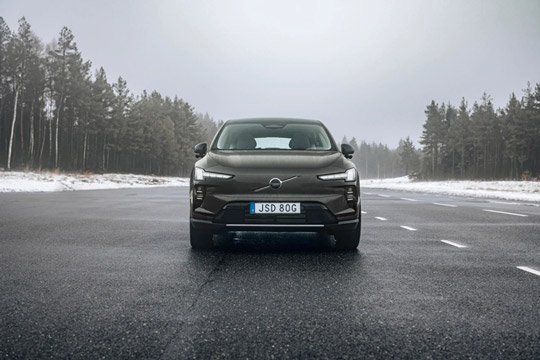
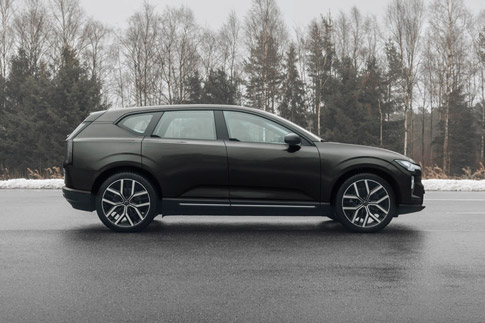
The vehicle’s side profile presents a sleek crossover stance. Flush door handles optimize aerodynamic performance. Volvo comprehensively optimized the body design. As a result, the EX60’s drag coefficient is as low as 0.26. This plays a key role in enhancing range performance.
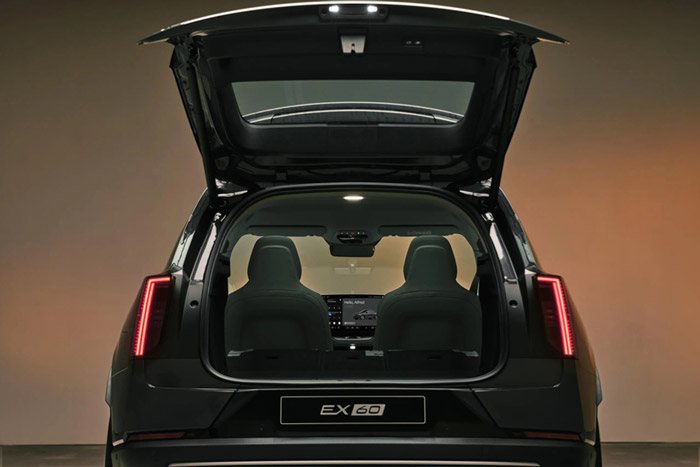
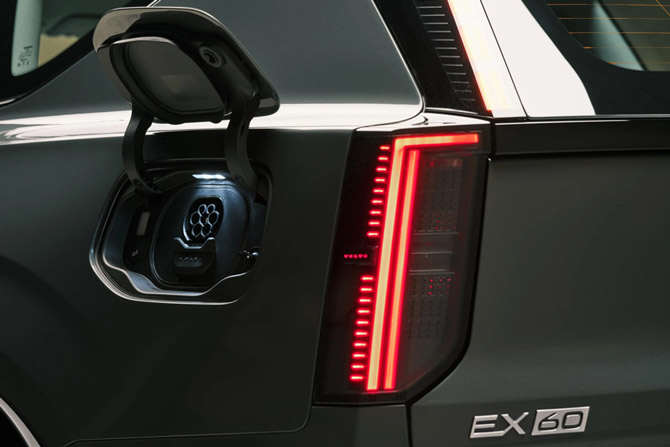
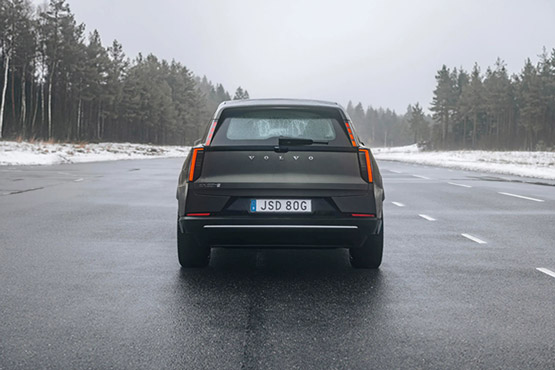
The rear design features a breakthrough. Vertical segmented LED taillights replace the C-shaped taillight design from the EX30 and EX90. Designers extensively apply black decorative elements in the taillight and bumper areas. This creates a strong sporty atmosphere. Volvo offers the vehicle in two exterior themes: “Bright” and “Dark.” The Bright theme features silver accents. The Dark theme receives a full black treatment. Both cater to different consumer aesthetic preferences.
Cross Country Off-Road Version
Volvo has also launched a Cross Country version for the EX60. This version increases ground clearance by 0.6 inches (approximately 15 mm) compared to the standard model. It also includes skid plates, wide-body wheel arches, exclusive 21-inch wheels, and a unique Frost Green body paint. Furthermore, it comes with adaptive air suspension and an off-road mode. This setup balances light off-road capability with everyday practicality.
Interior Design: Balancing Technology and Comfort
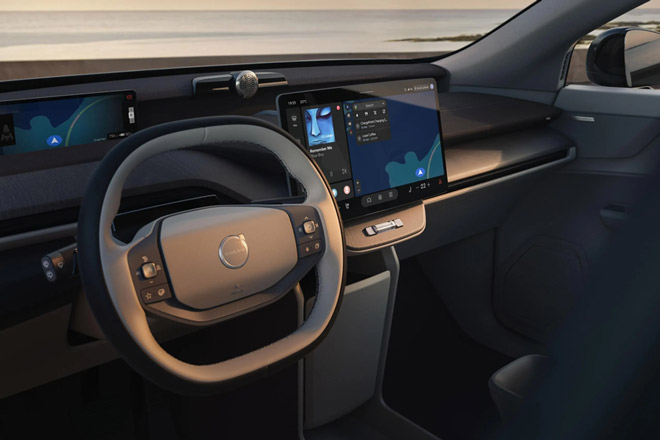
Upon entering the cabin, users encounter typical Scandinavian minimalist design. The layered dashboard paired with two-tone interior trim creates a warm and modern cabin atmosphere.
The center console area features a 15-inch OLED touchscreen, running the Android Automotive OS smart cockpit system. The system integrates the Google Gemini AI assistant, supporting natural voice interaction and continuous conversation functionality. The automaker states that the infotainment system responds quickly and operates smoothly. Moreover, they optimized the user interface for efficient access to core functions.
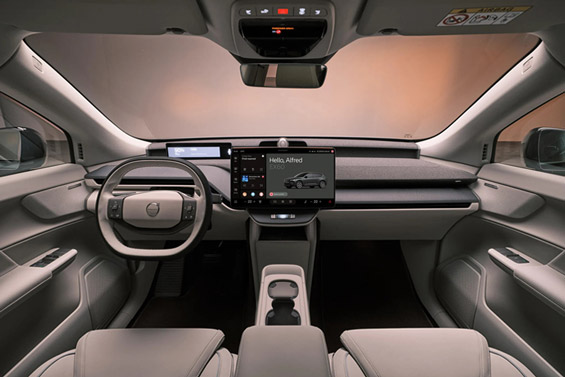
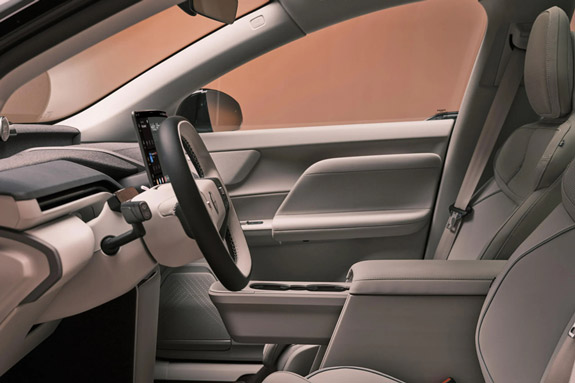
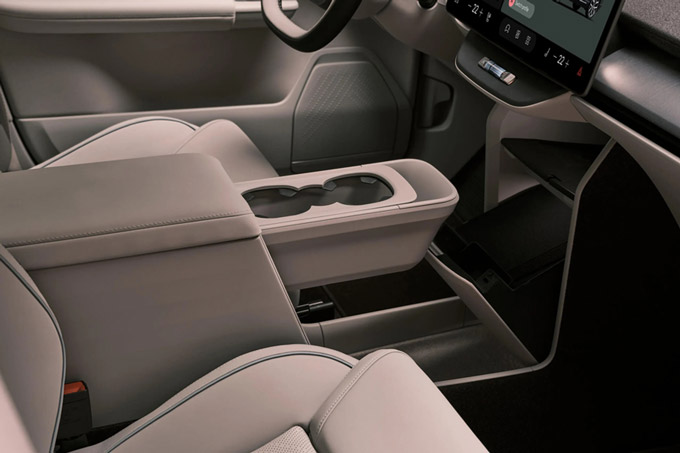
An 11.4-inch digital instrument cluster sits ahead of the driver, providing clear driving information. Volvo makes a driver display standard across the entire lineup. This departs from the radical choice of eliminating the instrument panel on the EX30. It indicates a strategic adjustment back towards pragmatism.
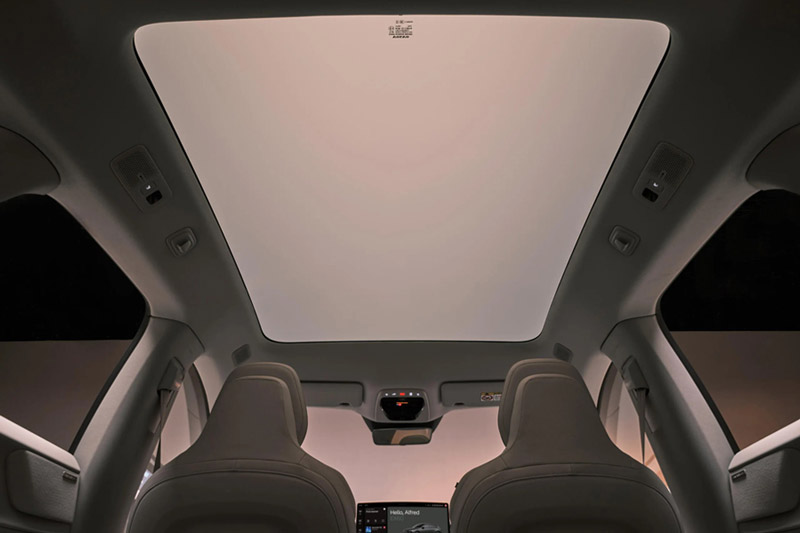
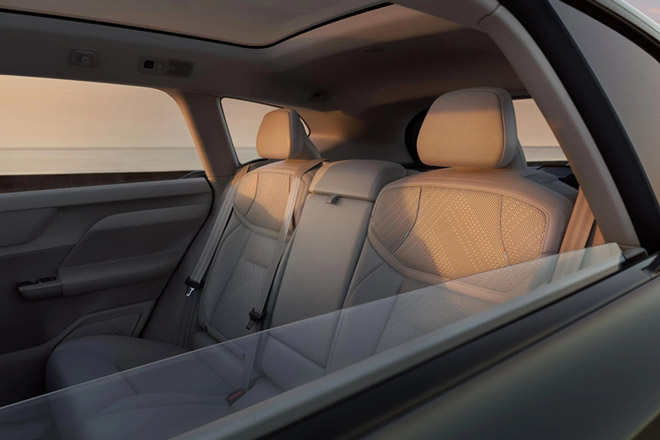
In terms of audio systems, the EX60 comes standard with a 21-speaker Bose sound system. Higher-spec versions upgrade to a 28-speaker Bowers & Wilkins premium audio system, which includes four headrest speakers. This creates an immersive listening experience.
In the field of safety innovation, the EX60 debuts Volvo’s newly patented multi-adaptive seatbelt technology. This seatbelt automatically adjusts the tightening force based on vehicle speed and collision direction. It provides superior passive safety protection for front occupants of different body types.
Global Market Strategy: Pricing, Rivals, and Launch Timeline
United States Market
In the United States, the 2027 Volvo EX60 has a starting MSRP of $58,400. This figure excludes a $1,395 destination charge, so the total comes to $59,795. This pricing carries a clear competitive intent.
Specifically, the base EX60 P6 Plus starts at $59,795, while the P10 AWD Plus starts at $62,050. By comparison, the BMW iX3 starts at approximately $62,850. Consequently, the EX60 undercuts it by about $3,100. At the same time, the EX60 also costs clearly less than the XC60 plug-in hybrid version (starting at approximately $63,940). This achieves a pricing breakthrough where “electric is cheaper than gasoline.” The top-tier P10 AWD Ultra version costs $68,745.
Production of the P6 and P10 versions began in spring 2026. US consumers can place pre-orders in late spring. Deliveries of the first units start in the summer. Volvo will launch the flagship P12 version slightly later.
Australian Market
In Australia, the EX60 will initially launch in two configurations. The Ultra P6 RWD starts at $86,990 AUD (excluding on-road costs). The Ultra P10 AWD starts at $101,990 AUD. This pricing also noticeably undercuts the BMW iX3 in Australia. It demonstrates Volvo’s consistent price competition strategy across global markets. Deliveries in the Australian market will commence later in 2026.
European Market
In Europe, the EX60 starts at €66,500 in France. Volvo expects initial deliveries to begin in September 2026. Under the WLTP standard, the P6 version offers a range of 620 km, the P10 version 660 km, and the P12 version can reach up to 810 km. Among these, the P12 version’s 810 km WLTP range undoubtedly becomes one of the model’s core competitive strengths in the European market.
Competitive Landscape
Globally, the EX60 directly competes with German luxury electric SUVs such as the BMW iX3, Mercedes-Benz GLC EV, and Audi Q6 e-tron. Additionally, although the Tesla Model Y occupies a slightly different position, its price range overlaps, making it a formidable competitor.
Notably, the EX60 consistently undercuts its German competitors in pricing across all major markets. This strategy helps Volvo rapidly capture market share. Moreover, it demonstrates Volvo’s proactive response to pressure from the global expansion of Chinese brands.
Can the EX60 Become Volvo’s “Game Changer”?
Product Competitiveness Analysis
From a product strength perspective, the 2027 EX60 indeed possesses several key elements to become a market leader.
On the technical level, the SPA3 platform’s 800V architecture, 400 kW ultra-fast charging capability, and WLTP range of up to 810 km all rank in the industry’s top tier. The native NACS charging port, which grants access to the Tesla Supercharger network, stands out as a major practical highlight. On the pricing level, the EX60 costs less than German rivals like the BMW iX3 and Mercedes-Benz GLC EV across major markets. In the US market, the starting price of $59,795 even undercuts the XC60 plug-in hybrid version. This shatters the ingrained perception that electric vehicles are necessarily more expensive.
On the design level, the Nordic minimalist aesthetic combined with a low drag coefficient of 0.26 achieves a unity of form and function. The in-car smart cockpit integrates the Google Gemini AI assistant, providing a smooth and natural interactive experience.
Potential Challenges
Of course, the EX60 also faces significant challenges.
First, competition in the global electric vehicle market is intensifying daily. In China, new power brands like Li Auto, AITO, and NIO are rising rapidly. In European and American markets, several trends intensify competition. These include Tesla’s continuous price cuts, the accelerated electrification of German luxury brands, and the accelerating overseas expansion of Chinese brands.
Second, uncertainty in global trade policy persists. For example, the US imposes tariffs on Chinese-made vehicles. The EU conducts an anti-subsidy investigation into Chinese electric vehicles. Such factors could potentially affect Volvo’s global supply chain layout and cost structure.
Third, consumer concerns about EV residual values, battery degradation, and charging infrastructure still exist. These factors may constrain some consumers’ purchase intentions in the short term.
Conclusion: Volvo’s Strategic Choice in an Era of Transformation
The launch of the 2027 Volvo EX60 is not merely the unveiling of a new car. It symbolizes the firm determination of this nearly century-old Swedish luxury automaker on its path to electrification.
The EX60 applies the SPA3 platform for the first time, implements 800V high-voltage fast-charging technology, achieves a breakthrough 810 km WLTP range, and adopts a pricing strategy lower than competitors across all markets. It responds to market doubts about Volvo’s electrification progress with tangible product strength. As the electric successor to the XC60, the EX60 inherits the Volvo brand’s consistent safety DNA and Scandinavian design aesthetics. At the same time, it comprehensively surpasses traditional internal combustion engine models in three-electric technology, smart cockpit features, and charging experience.
Key Specifications at a Glance
| Version | Powertrain | Power | Torque | 0-60 mph | Battery | Range (EPA) | Fast Charging Power |
| P6 RWD | Single Motor Rear-Wheel Drive | 369 hp | 354 lb-ft | 5.7 sec | 83 kWh | Approx. 307 miles | 320 kW |
| P10 AWD | Dual Motor All-Wheel Drive | 503 hp | 524 lb-ft | 4.4 sec | 95 kWh | Approx. 322 miles | 370 kW |
| P12 AWD | Dual Motor All-Wheel Drive | 670 hp | 583 lb-ft | 3.8 sec | 117 kWh | Approx. 400 miles | 400 kW |
Range figures come from EPA and WLTP standards; actual performance may vary depending on driving conditions and vehicle configuration.


