

- Official recommended replacement interval: Start with the owner’s manual
- Why might your replacement interval be different from others?
- Observe the symptoms: Your car is sending out distress signals
- A DIY inspection: The 30-second visual check method
- The huge cost of not replacing it on time: You save a small amount but end up spending a lot
- Replacement in practice: Choose OEM parts or high-performance parts?
- Final conclusion: A clear action guide for you
Do you feel that your car has become sluggish and lacks acceleration? Is fuel consumption higher than before? Many car owners will first check the tires or spark plugs. However, they often overlook one of the most inconspicuous components. That component is the engine air filter. It is just like the engine’s “mask.” Its workload is extremely heavy. You must replace it regularly. So, how often should you replace your car’s air filter? The answer depends on a variety of factors. Don’t worry. This guide will break down every key point for you step by step.
Official recommended replacement interval: Start with the owner’s manual
First, you should open your vehicle’s owner’s manual. The automaker will give clear recommendations in the maintenance schedule. Most ordinary family cars recommend replacement every 15,000 to 30,000 kilometers. Some Japanese models even recommend replacement as often as every 12,000 kilometers. High-performance turbocharged engines have higher requirements for intake air quality. Therefore, their replacement intervals are often shorter. You cannot blindly copy other people’s experience. The “severe conditions” maintenance schedule in the manual is very important. You will understand the reason shortly.
Why might your replacement interval be different from others?
There is no fixed number that fits everyone for how often a car air filter should be replaced. Manufacturers distinguish between two types of driving environments. The first is “normal driving.” The second is “severe driving.” In fact, the daily driving of the vast majority of car owners falls into the severe driving category.
Specifically, if you frequently encounter the following situations, you are in a severe driving environment:
- You are stuck in stop-and-go traffic in urban congestion every day.
- You often drive on sandy, gravel roads or near construction sites.
- The area where you live has dry air and is very dusty.
- You frequently make short trips, and the engine shuts off before reaching operating temperature.
Under the above conditions, the air filter will quickly become clogged with particulate matter. Therefore, you need to cut the replacement interval in half. You can check and replace it every 6 months or every 8,000 to 10,000 kilometers. Remember, a dusty environment is the number one killer of filters.
Observe the symptoms: Your car is sending out distress signals
You should not rely solely and rigidly on the odometer. Your car will tell you through some obvious symptoms that the filter has failed. You must learn to recognize these warning signs. As soon as you notice any of the following signs, check the filter immediately.
- Noticeable power loss: You step hard on the accelerator, but the engine response is very sluggish. This is because there is not enough air to participate in combustion.
- Abnormal increase in fuel consumption: Modern engines are controlled by a computer for fuel injection. Insufficient intake air will cause the computer to mistakenly enrich the fuel mixture. The result is that you find yourself refueling significantly more often.
- Black smoke from the exhaust pipe: Unburned gasoline exits through the tailpipe. This is a typical phenomenon of an incorrect air-fuel mixture ratio.
- Severe shaking at idle: When you are waiting at a red light, irregular vibrations come from the steering wheel or the vehicle body.
- The check engine light turns on: The intake air flow sensor detects abnormal data. It will also trigger an alarm because of this.
More importantly, these symptoms not only affect the driving experience but are also slowly damaging the engine. You should take action immediately.
A DIY inspection: The 30-second visual check method
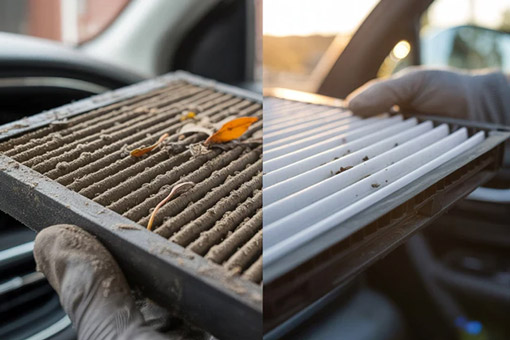
You may think it is difficult to do it yourself. That is not the case. Checking the air filter is the easiest item in car maintenance. You do not need any professional tools. You just need to open the hood. Next, locate that black plastic box. Usually, there is a thick intake pipe connected to it. Then, you can open the surrounding metal clips, or directly unscrew the screws. After you take out the paper filter element, hold it up to the sky or shine a flashlight behind it. If you cannot see light penetrating through the filter paper, or the gaps in the filter paper are filled with dead leaves, small insects, and dirt, it must retire. Even if the dust color is just grayish, the micropores of the filter paper are already clogged. At this point, do not slap the filter to try to shake off the dust. Slapping will damage the fiber structure of the filter paper and create invisible holes. You should replace it with a new one directly.
The huge cost of not replacing it on time: You save a small amount but end up spending a lot
Some car owners delay the replacement time in order to save money. This is a very dangerous misconception. First, a clogged filter will greatly increase intake resistance. Then, carbon deposits will form inside the engine. Carbon deposits can cause the piston rings to stick. In addition, unfiltered fine dust will directly enter the cylinders and wear down the cylinder walls like sandpaper. This will lead to oil burning and decreased cylinder compression. Eventually, the expensive oxygen sensor and three-way catalytic converter will also be poisoned and scrapped prematurely. Therefore, replacing a filter that costs only a few dozen yuan is actually protecting precision components worth tens of thousands of yuan. You must not be penny-wise and pound-foolish.
Replacement in practice: Choose OEM parts or high-performance parts?
When you decide to replace, you will encounter two mainstream choices. The first is the ordinary paper air filter. The second is the washable high-flow air filter.
Ordinary paper air filters are inexpensive. Their filtration accuracy is very high. You should stick to the principle of “use once and throw away.” They cannot be washed. Cleaning agents will destroy the glue of the filter paper. For most family users, we strongly recommend that you regularly replace the OEM or a major brand’s paper filter element.
On the other hand, washable air filters use cotton gauze or foam material. You can use a special cleaning kit. Its intake resistance is smaller and can even slightly improve throttle response. However, its maintenance must be extremely regular. You need to clean it every 5,000 kilometers. After cleaning, you also need to correctly spray on filter oil. If you apply too much oil, it will contaminate the intake sensor. If you do not have the patience for hands-on work, please choose with caution.
Final conclusion: A clear action guide for you
So, how often should you replace your car’s air filter? You can follow this golden rule:
Every time you go for routine vehicle maintenance, you must ask the technician to inspect the air filter. If the air quality in your area is acceptable, replace it every 12 months or 20,000 kilometers. If you are in a dusty city or mountainous area, replace it every 6 months or 10,000 kilometers. Even if you use your car very little, because the filter paper can get damp and age, you must still replace it at least once within a year.


