

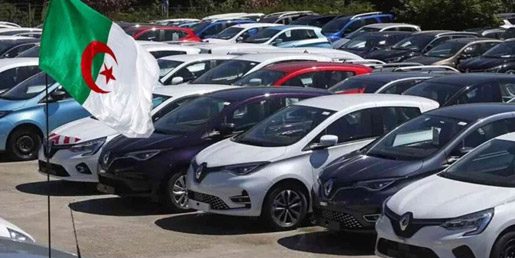
Algeria’s used car market differs significantly from most global markets. The government has implemented a strict import quota system since 2016, which severely constrains the supply of new cars. Consequently, used cars have become exceptionally sought-after. This is especially true for vehicles aged 1–3 years. In fact, a rare phenomenon has emerged where used car prices exceed their original new-car prices.
01 Market Particularity
In Algeria, the government enforces a strict quota system for automobile imports. Since 2016, it has limited the volume of car imports to approximately 150,000 vehicles annually. This figure marks a significant reduction from the previous scale of 400,000 to 500,000 vehicles per year.
In subsequent years, the authorities have continued to tighten quotas. They have even suspended the issuance of car import licenses at times. This policy has caused a severe shortage of new car supply. Therefore, a considerable portion of vehicles on the roads are now over 20 years old.
Government regulations allow personal imports only for gasoline-powered cars, electric vehicles, or hybrid vehicles under 3 years of age. They completely prohibit diesel vehicles. This policy has directly increased the popularity of clean energy models.
Used car transactions account for 40% of Algeria’s entire automotive market. This means that for every 10 cars sold, 4 are used.
02 Depreciation Rate Data
In Algeria, car depreciation trends run opposite to global markets. General global patterns show that cars depreciate significantly in the first few years. The rate then gradually slows as the vehicle ages.
Under normal circumstances, cars aged 1–2 years have an average annual depreciation rate of 20%–30%. For those aged 3–5 years, the rate is 15%–20%.
However, Algeria presents an entirely different situation. Strict import restrictions and strong market demand have altered the norm. For instance, a used sedan produced in 2017 can sell for 4.5 million Algerian Dinars in Algiers. This is equivalent to approximately $25,000.
Notably, this price already far exceeds what many car buyers can afford.
| Vehicle Age | Typical Global Market Depreciation Rate | Actual Performance in Algerian Market |
| 1 year | Depreciation of 20%–30% | Price stays close to or even exceeds the original purchase price |
| 2 years | Continued depreciation of 15%–20% | Prices remain stable; demand exceeds supply |
| 3 years | Cumulative depreciation can reach 40%–50% | Vehicles maintain high residual value; prices for some models remain firm |
03 Key Factors Affecting Depreciation
The vehicle model significantly influences used car prices in Algeria. Premium brands typically command higher prices for their used cars. Their relative scarcity and perceived higher reliability in the market cause this.
In contrast, Japanese brands like Toyota, Honda, and Nissan offer relatively more affordable prices. Their greater supply in the Algerian market explains this difference.
Vehicle type also significantly impacts prices. Buyers generally pay higher prices for used SUVs and pickup trucks. These vehicles offer greater utility in Algeria’s rural areas and on challenging terrain.
Conversely, compact cars and hatchbacks have relatively lower prices. They are better suited for urban environments.
Government policy is one of the most crucial factors affecting car depreciation in Algeria. The 2025 Finance Law stipulates that owners cannot resell imported used cars within 3 years of customs clearance. An exception exists only if they reimburse any previously enjoyed tax benefits.
Furthermore, the method for calculating customs duties will change starting July 2025. Authorities will no longer reference European market prices. Instead, they will use the actual purchase invoice. This change makes cars from non-European countries (such as China) more price-competitive.
04 Practical Car-Buying Advice
Purchasing a car aged 1–3 years in Algeria requires extra caution. Foreign exchange controls place the black-market Euro rate 30%–40% higher than the official price. This difference almost doubles the cost of imported cars.
For a car with a CIF (Cost, Insurance, and Freight) value of $10,000, consumers may need to pay between $22,000 and $25,000 after adding various fees.
The car purchasing channel is also an important factor. Formal channels import approximately 60% of used cars. These require local agents to assist with certifications and inspections. Completing this process takes about 45–60 days.
Smuggled vehicles constitute the remaining 40%, primarily from Spain and Turkey. They cost 15%–20% less than formal channel cars but lack after-sales guarantees.
Consumer preferences are also noteworthy. Younger buyers favor economical Japanese and Korean models around 3 years old, such as the Toyota Corolla. Priced between $12,000 and $18,000, these account for 55% of transaction volume.
Meanwhile, middle-to-high-income earners prefer used German luxury cars like the BMW 3 Series. With an average 2024 price around $35,000, they account for 20% of transaction volume.
Algeria’s car depreciation pattern stands as a unique global market case. In this country, cars aged 1–3 years not only avoid significant depreciation. They may also maintain exceptionally firm market prices, sometimes even exceeding the original purchase price. The government’s strict automobile import restriction policies drive this anomalous phenomenon. These policies artificially create a shortage of new car supply, thereby inflating the asset value of high-quality used cars.


