

In the luxury mid-to-large SUV segment, the Audi Q7 has always been a significant name. As the second mid-cycle refresh of the second-generation model, the 2025 Audi Q7 does not undergo a complete overhaul but rather solidifies its position through meticulous refinement.
Facing pressure from the Cadillac Escalade in the U.S. market and the siege of “new forces” like Li Auto L9 and AITO M9—alongside the growing presence of Chinese cars for sale—in the Chinese market, is this generation Q7 “too old” or “still going strong”? Setting aside sentiment, we analyze its strengths and weaknesses directly from global evaluation data.
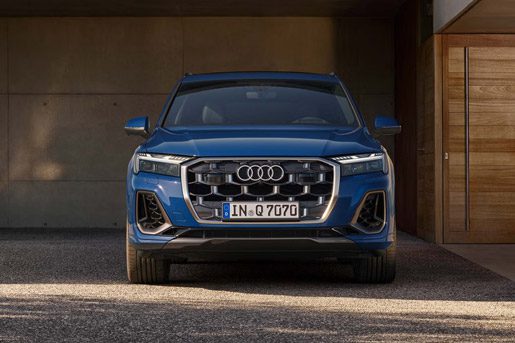
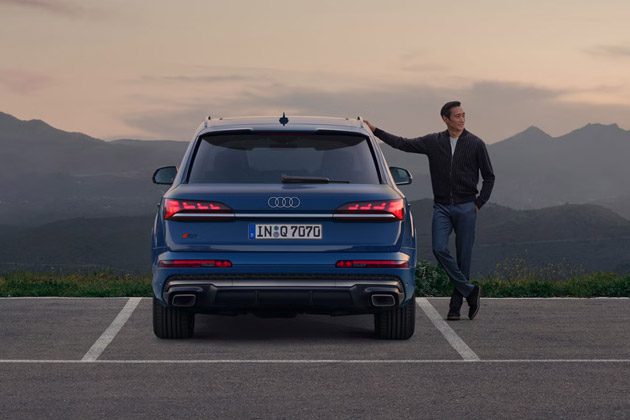
Strengths: Why do seasoned drivers still buy it?
First, mechanical quality remains a “hard currency.”
Anyone who has driven an Audi Q7 finds it hard to forget the “rock-solid” feel. The 2025 Audi Q7 is equipped with a 3.0T V6 engine + 48V mild hybrid system, delivering a maximum power of 250kW and peak torque of 500N·m. This engine’s output isn’t aggressive, but it’s extremely responsive. Paired with the same 8-speed Tiptronic automatic transmission found in the Porsche Cayenne, the shifting logic is remarkably intelligent.
Second, the chassis tuning is top-tier.
Full-size adaptive air suspension comes standard, a soul-defining feature of the Q7. In Australian reviews, media praised it for “smoothing out the road even with 22-inch large wheels.” At high speeds, the suspension automatically lowers by 15mm to enhance stability; on unpaved surfaces, you can raise it by 60mm, achieving a ground clearance of 245mm.
Additionally, it offers the largest rear-wheel steering in its class at 5 degrees. This allows a vehicle over five meters long to achieve an exceptionally tight turning diameter. Driving it feels incredibly agile, nothing like handling a large car.
Third, genuine seven-seat space.
Note that the third row in many SUVs is a “small bench,” but the Q7’s third row can accommodate adults up to 175cm tall for short to medium trips. The trunk space is even more impressive: 295 liters with the third row up (Australian data), expanding to 780 liters with the third row folded, and up to 1,908 liters with all seats flat. These figures far exceed the BMW X5 and Mercedes-Benz GLE.
Fourth, true Quattro full-time all-wheel drive.
Unlike some “Quattro Ultra” systems based on front-wheel-drive transverse platforms, the 2025 Audi Q7 still employs a purely mechanical center differential. In roller group tests, it can easily escape with traction on a single wheel—a capability that off-road enthusiasts value most.
Weaknesses: Vulnerabilities “struck down” by new forces
First, the infotainment intelligence lags significantly.
This is a major point of criticism from global media. Although equipped with a virtual cockpit and three-screen interaction, the 10.1-inch central control screen of the 2025 Audi Q7, in terms of both interface UI and response speed, falls behind Audi’s own Q6 e-tron, let alone Tesla or Chinese new energy brands.
More critical is stability. Australian journalists found in real-world tests that wireless Apple CarPlay frequently experiences connection failures and Bluetooth errors, sometimes requiring a phone restart to resolve. The voice control system can only handle basic functions and cannot sustain continuous dialogue or control windows and air conditioning deep adjustments.
Second, cost-saving compromises in paintwork and materials.
Professional vehicle evaluation revealed that the average paint film thickness of the 2025 Audi Q7’s body is approximately 75.6μm. This ranks at the lower end among luxury brands. While it doesn’t affect aesthetics, its protective ability against stone chips during long-term parking is somewhat weaker.
Third, interior storage space design is “user-unfriendly.”
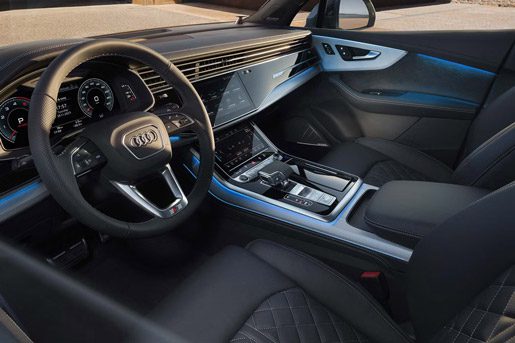
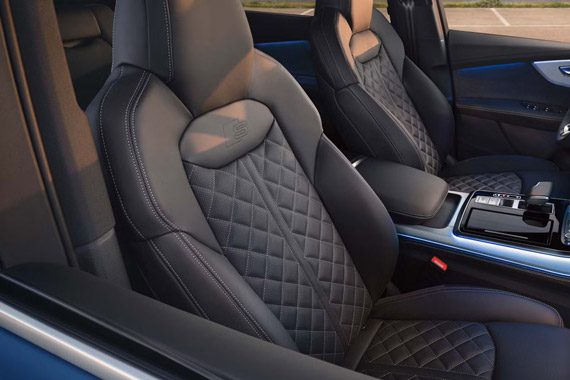
In such a large car, the front row surprisingly lacks a proper place to put a phone. The wireless charging pad is placed inside the center armrest box, positioned both deep and hard to see, making it extremely inconvenient to access. The cupholder area is also relatively compact, reflecting the arrogance of traditional fuel vehicles in ergonomic details.
Fourth, third-row accessibility is compromised.
Although space is adequate, the entrance to the third row is narrow. More awkwardly, when the second-row seats are adjusted to the rearmost position, they physically block the electric folding button for the third row, forcing you to run back and forth to manually adjust the seats before folding them.
The 2025 Audi Q7 is not a perfect car. It appears slow to respond in the digital wave and makes compromises in detailed craftsmanship. But the moment you grip its steering wheel, roll over the first speed bump, or accelerate out of a corner in the rain, you understand—some people write poetry with words; Audi writes poetry with machinery. This steadfastness is still worthy of appreciation from those who know a good thing when they see it.


